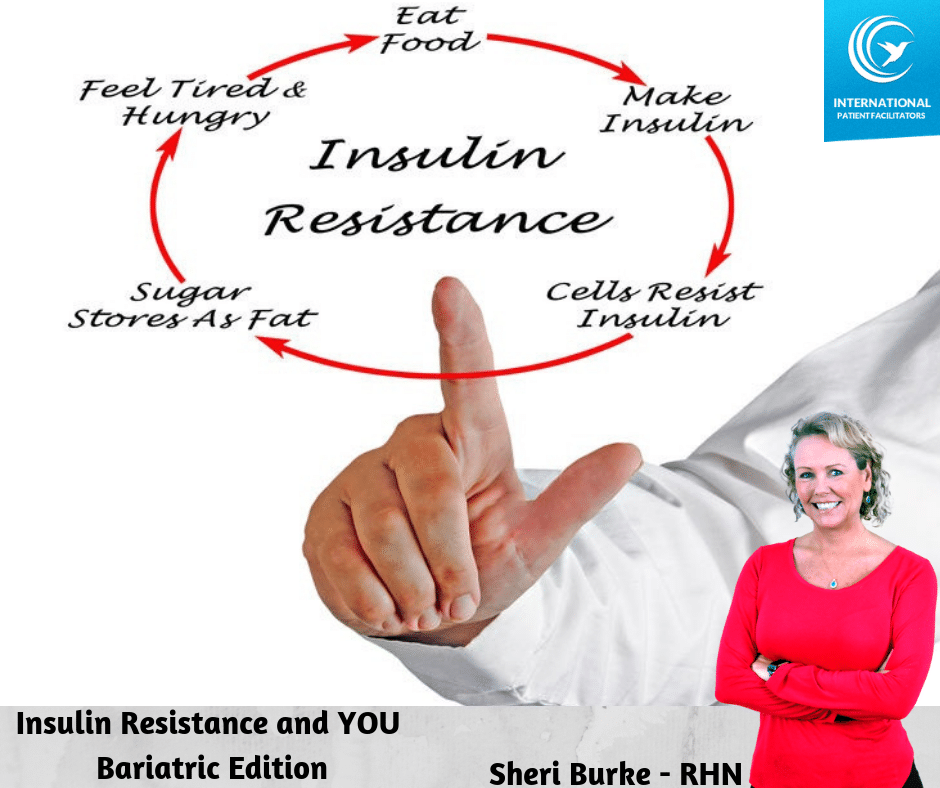
consider myself fortunate. I am fortunate because I get to write about important issues that affect my clients and their health. I also get to educate them about the serious stuff and then offer effective solutions. These solutions enable my clients to THRIVE and not just survive.
This is my chance to discuss INSULIN. It affects ALL of us.
Obesity is a disease, it’s not something created by lack of character. It is a hormonal disease…. and there are many hormones involved and one of the main ones is a hormone called INSULIN.
INSULIN, It’s all about insulin so let’s first understand insulin and then we can better understand WHY and HOW we should be adapting to a ketogenic diet post-bariatric surgery …
This part really excites me because if I can explain how the hormone insulin works, it is then going to make perfect sense to you and you will know why we need to take this way of eating seriously.
This information is not only for our recent post-op individuals, but it is also for those of you who are one year, five years, and twenty years post-op. Heck, it is for ALL of us.
Let’s allow insulin to take center stage for a few moments…
Most obese individuals are resistant to the hormone insulin. So what does that mean exactly? To be resistant to insulin?
Well, insulin resistance is essentially a state of pre-pre diabetes.
Insulins’ job is to drive glucose or blood sugar into the cells where it can be used.
In a nutshell, when someone is insulin resistant, they are having trouble getting blood sugar to go into those cells. And blood sugar can’t just hang out in the blood when we eat or we would all have a diabetic crisis every time we eat.
So when someone is resistant to insulin, the bodies response to this is to just make more of it, and insulin levels will rise and rise and for a while, for years, blood sugar levels can even remain normal.
However, usually, it can’t keep up forever. And even those elevated levels of insulin are not enough to keep blood sugar in the normal range. So it starts to rise. That’s diabetes!
It probably won’t surprise you to hear that most of my clients have insulin resistance or diabetes.
And if you are thinking, “phew, that’s not me”, you actually might want to think again, because almost 50% of adult Americans now have diabetes or pre-diabetes.
That’s almost 120 million people. But that’s hardly everyone who has issues with insulin.
As I was saying, people have elevated insulin levels due to insulin resistance for years and even decades before the diagnosis of even pre-diabetes is made.
Plus, it has been shown that up to 25% of normal weight adults are also insulin resistant.
So in case you are keeping track, this is a heck of a lot of us!
So the trouble with insulin resistance is: if it goes up, we are at great risk for developing type 2 diabetes, but also, INSULIN MAKES US HUNGRY!
….. and the food we eat, much more likely is going to be stored as FAT.
Insulin is our fat storage hormone. So we can start to see how it’s going to be a problem for diseases like obesity and metabolic issues like diabetes.
But what if we trace this problem back to the beginning? And we just didn’t have so much glucose or sugar “hanging around” that insulin needed to deal with.
Let’s take a look at how that would look.
Everything you eat is either a carbohydrate, a protein or fat. They each have a very different effect on glucose and insulin levels.
When we eat carbohydrates, our insulin and glucose are going to spike up fast. With proteins, it looks a lot better. But when we eat fat, nothing happens. We get a flat line.
This is going to wind up super important!
I want to translate the carbohydrate, protein and fat graph for you into a real-life situation. I want you to go back and think about the last time you ate at one of our many fast food joints. Call it a hamburger with fries and a coke.
We all know that there are rules associated with this. The first rules are that you are going to eat too much.
The second rule is that you are STARVING one hour after you eat.
Why? Well, because the carbs in that meal caused glucose and insulin to skyrocket, which triggers hunger, fast storage, and cravings.
So if you are insulin resistant, to begin with, and your insulin levels are already higher, you really are hungrier all the time.
And we have this setup – eat carbs, your glucose does up, your insulin goes up, and you have hunger and fat storage.
So what do a lot of doctors and dieticians recommend that these people eat? Or what have they been told up to now?
My Mother is a diabetic. She has been a diabetic on medication for many, many, many years. This is what her team of caregivers tell her to do (not her daughter, her “other” team). She has been following their advice for many years also.
I am using type 2 diabetes and my Mother as an example of the bad food advice we all have been given in recent years.
My Mom is told to consume 40 to 65% of her diet in carbohydrates per day. Guys! That is A LOT of carbs.
Remember what is going to happen to glucose (blood sugar) and insulin – when we eat them?
Yes, they are essentially recommending that my Mom eats exactly what is causing her problem.
It really sounds crazy and it really is crazy. Because at its root, her diabetes is a state of carbohydrate toxicity.
We cannot get the blood sugar into the cells, and that causes a problem in the short them, but in the long term, consequences are even greater.
And going back to insulin resistance, this is essentially a state of carbohydrate intolerance.
So why is my Mom recommended to eat them?
Diabetes Canadian guidelines specifically state that there is inconclusive evidence to recommend a specific carbohydrate limit. But those guidelines go right on to say what we all know …. Carbohydrate intake is the SINGLE biggest factor in blood sugar levels and therefore, the need for medication.
These guidelines then go on to say, “hey look, if you are taking insulin or certain diabetic medications, you HAVE to eat CARBS, otherwise, your blood sugar can go too low.
Let’s take a look at the vicious cycle that advice just set up. It is to eat carbs, so you have to take medication, then you have to eat more carbs, so you avoid the side effects to those medications …. And around and around we go.
Consider carbs – first, here’s a shocker for you – we don’t need them. Seriously, our minimum daily requirement for carbohydrates is ZERO. We have essential amino acids (those are proteins). We have essential fatty acids (fats) but nope, no essential carbohydrates.
A nutrient is essential IF we have to have it to function, and we cannot make it from something else. We make glucose and plenty of it all the time. It is called gluconeogenesis.
So we don’t need carbs, the overconsumption of them is making us very ill, yet we are continuing to see them recommended to clients (like my Mom) – to consume more than half their total energy intake every day from them.
It doesn’t make sense.
Let’s talk about what does make sense… cutting carbs – A LOT. I teach clients to eat with carbs as the minority of their intake and not the majority.
So how does that work or what does that look like?
How does somebody eat this way?
First, let me tell you what keto is not – low carb is not ZERO carbs… and it is NOT high protein.
These are common criticisms that are so frustrating because they are not true.
Next, if we take away the carbs, what are we going to put in?
Because remember, there are only 3 macronutrients and if one goes down, one has to go up.
My clients eat FAT and a nice amount of it.
“What did you say? What’s going to happen if I eat fat”??
Well let me tell you …. You are going to be happy! Because FAT tastes GREAT! And it is incredibly satisfying.
But remember, fat is the only macronutrient that is going to keep our blood sugar and insulin levels low and that is so important.
So now I want to share some of my simple ideas for eating.
These are going to be even more important if you are one of the tens of millions of Americans who have troubles with insulin levels.
My first thought: if it says light/ low fat or fat-free, it stays in the grocery store because if they took the fat out, they put the carbs and chemicals in.
My second thought: Eat food. The most important rule in low carb nutrition is that real food does not come in a box. No one should have to tell you that real food is “natural”. You should know when you look at it.
Don’t eat anything you don’t like.
An eat when you are hungry. Don’t eat when you are not hungry no matter what the clock says.
And finally, a simple way to remember what we want to avoid. NO GPS – No grains, no potatoes, and no sugar.
That’s a biggie, right? No grains? Ya, no grains. “But we have to have them”?
Nope – they are a carb.
“But whole grains are so good for us”?
Well, first of all, there are actually very few foods out there that are truly whole grain, even when they say they are.
Most foods that say they are whole grain are highly processed and the fiber benefit is ruined… or they are coming with highly refined flour and usually, they have both of these things.
So if you are one of the truly not insulin sensitive people, you can eat real whole grains but if you are in the enormous slice of the population with insulin issues, it is making things worse.
So what if you are not one of the insulin-sensitive people? Can you still eat this ketogenic, low carb way?
Of course, you can. I am a great example.
Two years ago I decided that I would cut my carbs as low as I recommend to my diabetic and pre-diabetic bariatric clients.
Now it is not mandatory for my health as it is for theirs. I am not insulin resistant yet. Would this be a problem?
No, that is just the thing. Unless you have an exceedingly rare syndrome, then cutting carbs is going to be good for you, even if it is not necessary.
I hope that this article helped you to better understand insulin and the role it plays in obesity and metabolic issues.
When we are able to better understand how food functions in our body, it is easier to understand the recommendations of why we should be following a low carb or a ketogenic diet.
Next week we are going to continue down this path and dive more into the actually recommended foods that we all should be consuming.
I salute you for taking control of your health and wanting to learn more about this lifestyle and why it is such a perfect way of eating to improve your health.
FaceBook LIVE 3pm EST on Friday, June 28th.